Friday, March 26, 2010

CANT GET YOU OUT OF MY HEAD: You Shook Me All Night Long

The Song: "You Shook Me All Night Long"
The Singers: AC/DC
The Songwriters: Brian Johnson, Angus Young, Malcolm Young

Satellite radio has much to recommend it. No commercials, an incredibly wide range of genres, and virtually no hosts (save for the presence of all four surviving MTV VJs on "80s on 8"). But once you get past that, there really aren't a lot of surprises. All the hits gets dragged out for another run. And that includes songs like this.

She was a fast machine
She kept her motor clean
She was the best damn woman that I ever seen


Let's just stop right there, because right off the bat, this is one of the funniest, most epic failures in the history of rock lyrics. We kick off with this ham-handed car metaphor, but then, only two lines in, the guy just gives up. It's like, after he came up with machine and motor, he couldn't think of another entendre to save his life. So he just gave up. "That's it, mates. I'm tapped out." BUT HE KEPT GOING WITH THE SONG! What happened? Did he come up with it in a freestyling throwdown? Did they accidentally record his first draft? I mean, at least TRY to be suggestive.

She had the sightless eyes
Tellin' me no lies
Knockin' me out with those American thighs


Oh, I'm sorry. So the girl is blind. I feel terrible now.

Wait. What?

Takin' more than her share
Had me fighting for air
She told me to come but I was already there


Oh...oh, wait a minute. Hang on just one cotton pickin' minute.

Is this song about sex?

'Cause the walls start shaking
The earth was quakin'
My mind was achin'
And we were makin' it and you -

CHORUS:
Shook me all night long
Yeah you shook me all night long


Look, I realize that 98% of rock songs are about sex. But there's something so basic, so blunt about these lyrics that if you think about them for more than two seconds, you won't be able to stop laughing. It's like the guys from AC/DC just got out of their first day of "Introduction to Metaphor" class, and were so excited that they just couldn't wait to try out their new-found skills.

Workin' double time
On the seduction line
She was one of a kind, she's just mine all mine
Wanted no applause
Just another course
Made a meal out of me, and come back for more


These aren't even actual sentences anymore.

This is normally the point at which I say something about the band. Not gonna happen. I don't give a whit about AC/DC. They specialize in a brand of music that I've sometimes heard called "hard rock" and other times called "metal" but which I know best as "music Shane doesn't particularly care for". Some songs, however, transcend their genre to become truly ubiquitous. And then I hear those songs on satellite radio, and they attach to my brain like remoras, and I have to write about them to get them out. And here we are.

Had to cool me down
To take another round
Now I'm back in the ring to take another swing


And now it's about boxing. Let's see if the folks at Songfacts can help me out.
Johnson came up with the line "She was a fast machine, she kept her motor clean" when he realized that cars and women were very much alike - they go fast, let you down, but then make you happy again when you see the new model. AC/DC has never been known for deep, meaningful lyrics.
Thank you, Songfacts. Thank you so much.

'Cause the walls was shaking
The earth was quakin'
My mind was achin'
And we were makin' it and you -

CHORUS:
Shook me all night long
Yeah you shook me all night long


I wonder what would happen if you didn't try to be coy about it (and I'm being REAL generous describing AC/DC as "coy" here) and just sang what you were actually talking about.

AND WE
WE HAD SEH--EH--EX
YEAH, WE
WE HAD SEH--EH--EX

Knocked me out and then you
Shook me all night long
Then you were shakin' and you
Shook me all night loooong
Yeah you shook me
Well, you took me

(guitar solo)


Speaking of guitar solos, I checked, and this song is available on Rock Band. But here's the thing: aside from the solo, it's a really repetitive song. It must be really tedious to play. And yet AC/DC has to play it at every single show. They can't avoid it. That must drive them nuts. It's like a hard-rockin', chick-bangin' Groundhog Day.

You really took me and you
Shook me all night long
Oaaaaaahhhhhh you shook me all night long
Yeah yeah you
Shook me all... night... long
Ya really took me and you
Shook me all night long


Is that it? Is that everything?

Yeah you shook me, yeah you shook me
All night loooong!


Okay, then.

Fun Fact: This is an actual thing. So is this. Makes you wonder how hard rock fans can live with themselves.

Friday, March 05, 2010

FINAL CUT: In the Big Blue World

So, I find myself in the awkward position of explaining why I think the highest-grossing film of all time doesn't suck.

(Just so we're clear, Avatar has only the 15th-highest gross when adjusted for inflation, and that's ignoring the huge surcharge attached to the 3-D glasses. No one cares about any of that, of course, but just so we're clear: box office reports? Lies!)

As one of the last 10 people in America to see Avatar (and that should go down to 9 if my wife chooses to see it instead of Cop Out), I'm well aware that I'm very late to the party to say much of anything about the movie. At the same time, that also means that I've had a chance to take in the observations of the rest of the civilized world. So I feel like I get to sit on a jury that is only just now learning the true facts of the case. So let's come to a verdict, shall we?

First off, we need to clarify which of two prevailing arguments about Avatar is true. It is either:

- A stunning achievement, using the most current movie technology to create visions never before seen in the most immersive cinematic environment yet devised.

or

- A tired rehash of hackneyed plots and pilfered set-pieces strapped to boatload of atrocious dialogue that no amount of visual effects can conceal.

Ha ha! I'm kidding! It's both. It is transforming AND unoriginal. It's breathtakingly wonderful AND sadly underwhelming. It's a floor wax AND a dessert topping. It is the London Symphony Orchestra playing "Twinkle, Twinkle, Little Star." The pros and cons are so clearly split that it is a film almost guaranteed to polarize its audience. Oddly enough, with so many films being made that make you go "eh", I actually think that's kind of a plus.

This dichotomy may make you split your feelings about the movie just as cleanly. I spent a couple hours arguing with one of the proprietors of the Critical End! movie review podcast and blog. He thought the effects were lovely and the story was so rote as to be insulting. So he gave the movie a rating of 5 out of 10. And I guess I get that. 10 for visuals, 0 for story... it averages out.

"But the look and feel of the film is so revolutionary," argues I, "that you have to set petty concerns about clichés and commend the film for its overall impact."

"The scope of the achievement," retorts he, "is exactly why I have to ding it for the crappy plot. With all that power comes great responsibility. It's like getting Renoir and having him draw Marmaduke. If you want pretty visuals without a compelling story, get a screensaver."

(Incidentally, Marmaduke is an actual movie. Coming this summer. With Owen Wilson voicing the title role. So...you know...that blows.)

We went on like this for a while, both of us respecting the other's position while still thinking him to be a raving nutcase. So here's my last stab at making a case for Avatar as worthy of the hype. To him, and to myself.

Is Avatar perfect? Hardly. There's plenty to pick on. The story is pinched from at least a dozen places. The subtitles are in Papyrus font. That song at the end is god-awful. Story non sequiturs abound, like an insubordinate pilot who is never punished for her dereliction. A giant fighting robot that, hilariously, has its own giant knife for up-close fighting. An extremely rare mineral which is given the accurate but still incredibly stupid and unoriginal name of unobtainium. Little things like this still nag at me.

And then there are bigger problems. The acting is mediocre at best. Our hero, played by Sam Worthington, sports an accent I can only describe as Australian-Brooklyn, which robs most of his big speeches of their gravity. Villains Stephen Lang and Giovanni Ribisi conceal their evil in no way whatsoever, depriving the film of potential suspense or character development. (Although Ribisi has several scenes where he appears to be conflicted, but for no obvious reason. It's like they're scenes of him playing a totally different character.) And Sigourney Weaver has it worst, trying mightily to come off convincingly as a peace-loving botanist whose every speech is in the tone of a hard-boiled Marine.

Ah, yes. The speech. Dialogue in this film is like a lead rainstorm. A character actually says "You are not in Kansas anymore." Another rallies the troops by telling them they will be fighting "for our children, and for our children's children." Plenty of people yell "Noooooo!" It is almost awesome to watch the film and see how many opportunities were not taken to find new ways of saying things.

So should we be critical of Avatar? Heck, yeah, and I hope it's clear that I am. But in the end, I am able to brush all that away. The plot, the characters, that stuff is not as good as it could be, but it doesn't ruin the film for me. And why not? Why am I willing to cut Avatar so much slack? The answer is a single word.

Titanic.

I haven't mentioned the name of the Grand Panjandrum responsible for Avatar yet. He's James Cameron, the film's director, writer (and lover of military jargon), editor, cinematographer, production designer, slavedriver, and all-around visionary. And the reason I've waited until now to bring him up is because he did all this exact same stuff on his last movie 12 years ago. A little thing called Titanic. And of course, the bastard's gone and done it again.

It has become fashionable to pick on Titanic for the lame dialogue (Tim Sniffen used to love throwing out the quote "Here's to making it count" at opportune moments), the lame romance ("I love you, Jack." "I love you, Rose." "I love you more, Jack." "Me, too, Rose."), the lame villain (ah, Billy Zane). But it was always clear to me that none of this was the point. James Cameron had one goal with Titanic: to put you on the boat as it sank. He enlisted every special effects trick in the book to bring that ship back to life in a way that made it impossible for you to doubt that you were seeing the real thing. Then he cobbled together a romantic couple that may not have been clever or original, but served the role of taking you to every essential part of the ship as it went down. Jack and Rose weren't characters. They were tour guides for history.

If Cameron is really copying anyone, it's himself. Avatar is all about this remarkable new world and these strange creatures. The Dances With Wolves storyline is good enough to get by. But the real goal is to put you on this planet, as thoroughly and convincingly as possible. Our protagonist, Jake...he doesn't have to be great. Once again, he's a tour giude for the fantasy. He's taking us to everything worth seeing.

I should say a word about the stupendous 3-D technology that makes you feel like you're enveloped in the film. The past few times I've tried to watch 3-D, it hasn't worked for me. I've gotten double-vision or blurring or dimness. Not so here. Cameron has broken the bank creating depth that really works, that is watchable without strain for nearly three hours, and he doesn't have to poke a single stick at the camera to let you know it's working.

So again, you may ask, "Why am I cutting him so much slack? So he makes great visual effects. So what?" And I guess the answer is because, to my mind, he's NOT making great visual effects. He's taking the visions in his head and putting them into ours. Look, a lot of filmmakers can give you special effects. Take hacks like Michael Bay or Roland Emmerich. From what I've seen in the trailers, Transformers 2 and 2012 are just dripping with effects. I can totally picture Emmerich telling a bunch of animators, "I wanna see the Christ the Redeemer statue blow up. Can you do that?" And they say yes, and you've got yourself a movie. You can lump George Lucas in there, too. The Star Wars prequels are bad in their own right, but the bigger issue is that the visuals just share the screen with the story, rather than serving it. Those three movies are essentially promotional reels for ILM. But that's all these directors are really doing: ordering off a menu. They don't have a vision.

James Cameron, God love him, has vision. He has things in his head, and if he has to take 12 years and invent whole new camera systems and push the limits of computer technology way past its limits to get what he wants, he'll damn well do it. He's been pushing the edges for a while now. The water alien in The Abyss took us to the liquid metal killing machine in Terminator 2, which was a short trip to the fully-realized RMS Titanic, which finally took us here. He's redefining the movies, and amazingly, doing it in a way that works.

One last analogy, which I hope will somehow finally illustrate my point. As you may know, George Harrison first discovered the sitar on the set of Help!, where it was included as a funny prop. But he was fascinated by the instrument, so he finally bought one (because he was a Beatle, and that's what you did when you got a little curious about something). And he fiddled with it, trying to play it like a guitar, and the instrument's exotic sound debuted with the Beatles as the perfect accompaniment to John Lennon's tale of infidelity, "Norwegian Wood (This Bird Has Flown)."

But Harrison wanted to know more, and he eventually studied with the world's foremost sitarist, Ravi Shankar. It was from Shankar that he eventually learned the right way to play a sitar. And that led to all kinds of other stuff, like Harrison's growing interest in Hinduism and the Beatles taking up with the Maharishi and whatnot.

But what's interesting here, I think, is that Shankar was never much impressed with Harrison's early dabbling on the instrument. Someone asked him why not, since George's sitar had lent such a stark and lovely counterpoint to the Beatles' music. Shankar replied that, for someone like him who knew the instrument so well, George's playing was still wrong, and it would be like praising a child for banging on a piano.

I guess what I'm saying is, in many respects, what filmmakers have been able to do with visual effects thus far has been very impressive. You need only look at this demo reel to see what visual artists are capable of, and how far-reaching and pervasive their work has become. But Cameron makes them all look like amateurs, dabbling on instruments they don't fully understand. He's Ravi Shankar, and everyone else is just banging on pianos.

I guess that's why I didn't think Avatar sucked.

Monday, February 15, 2010

CAN'T GET YOU OUT OF MY HEAD: Up, Up and Away

The Song: "Up, Up and Away"
The Singers: The 5th Dimension
The Songwriter: Jimmy Webb

So I'm playing a game called Songburst, wherein you compete against your friends by completing song lyrics. The words are printed on cards which, half the time, give you the wrong year, despite the fact that the correct year is printed on the bottom in really small type in the copyright data. Anyway, I was protesting one of the card's assertion as to how many times the word "balloon" actually appears in the refrain of The 5th Dimension's classic "Up, Up and Away" when I came to a bold realization: "Man, this is a stupid song." Don't misunderstand; I actually kind of like the song, in the way that I enjoy a number of cheesy things. But it's pretty stupid.

(Incidentally, you really must watch the video linked above. I'm not sure if it's more awesome because the costumes are so silly, because they're clearly lip-synching but still have to share microphones, or because the director insists on framing them so that they only fill the bottom half of the screen. It's as though the set designer told him, "I had better see all those giant dots I built, or I will kill you.")

Would you like to ride in my beautiful balloon
We could float among the stars together, you and I
For we can fly we can fly
Up, up and away
My beautiful, my beautiful balloon


Brace yourself, folks, because this is pretty much the whole song. If they ever try to make a Mamma Mia-style musical consisting entirely of 5th Dimension songs, this will not be one of the tunes that "advances the plot". It's pretty much: I got a balloon, it's cool, let's ride. Perhaps it will be a seduction scene. A very easy-listening, unsexy seduction scene.

The Songfacts website, which purports to give you facts about songs, contains this gem about this particular tune: "This song, more than any other, is associated with hot air ballooning." Thanks, Songfacts. Way to do your homework there.

The world's a nicer place in my beautiful balloon
It wears a nicer face in my beautiful balloon
We can sing a song and sail along the silver sky
For we can fly we can fly
Up, up and away
My beautiful, my beautiful balloon


It wears a nicer face?

It is almost a truism that white people will always end up trying to sound more black, rather than vice-versa. Proving a bold exception to the rule is The 5th Dimension, a group that boldly stands alongside The Carpenters and The New Christy Minstrels as purveyors of some of the whitest music ever produced. And I say this as a really, really white person. This is mean, what I'm about to say, and I'm just about positive that it isn't true and probably slanderous, but when I listen to The 5th Dimension, I feel like they absolutely would have played Sun City. You wonder how a group like this could happen. Did an all-Motown station accidentally play the Mitch Miller Singers, and these five people exclaimed, "What is that magnificent sound?"

Suspended under a twilight canopy
We'll search the clouds for a star to guide us
If by some chance you find yourself loving me
We'll find a cloud to hide us
We'll keep the moon beside us


Our songwriter here is Jimmy Webb, who is renowned for his, shall we say, unique approach to storytelling in song. Here, I'll give you the titles of a few of his little pop music symphonies and let you do the math -- "Galveston", "Wichita Lineman", and of course, God help me, "MacArthur Park". Yes, the same person responsible for "Someone left the cake out in the rain" also churned out this salute to hot-air ballooning. It all makes sense, really.

Love is waiting there in my beautiful balloon
Way up in the air in my beautiful balloon
If you'll hold my hand we'll chase your dream across the sky
For we can fly we can fly
Up, up and away
My beautiful, my beautiful balloon
Balloon...
Up, up, and away.....


Fun Fact: "Up, Up and Away" won the Grammy for 1967 Record of the Year. That's right. Out of all the music that debuted in that pivotal year, this was the best of the bunch. Here's just a handful of the tunes it was judged superior to:

"I'm a Believer" - The Monkees
"Tell It Like It Is" - Aaron Neville
"Standing in the Shadows of Love" - Four Tops
"Ruby Tuesday" - The Rolling Stones
"Mellow Yellow" - Donovan
"Gimme Some Lovin'" - The Spencer Davis Group
"Happy Together" - The Turtles
"There's a Kind of Hush" - Herman's Hermits
"For What It's Worth" - Buffalo Springfield
"Groovin'" - The Young Rascals
"Respect" - Aretha Franklin
"Windy" - The Association
"Can't Take My Eyes off You" - Frankie Valli
"Light My Fire" - The Doors
"A Whiter Shade of Pale" - Procol Harum
"I Was Made to Love Her" - Stevie Wonder
"White Rabbit" - Jefferson Airplane
"Reflections" - Diana Ross & the Supremes
"The Letter" - Box Tops
"Higher and Higher" - Jackie Wilson
"Brown Eyed Girl" - Van Morrison
"Gimme Little Sign" - Brenton Wood
"Soul Man" - Sam and Dave
"(You Make Me Feel Like) A Natural Woman" - Aretha Franklin
"I Say a Little Prayer" - Dionne Warwick
"I Can See for Miles" - The Who
"I Second That Emotion" - Smokey Robinson & the Miracles
"Judy in Disguise (with Glasses)" - John Fred & His Playboy Band
"Chain of Fools" - Aretha Franklin
"All You Need Is Love" - The Beatles

Think about it. To be better than all those songs? My gosh. I mean, you know what it is? It's humbling.

Yeah, right. Here were the songs actually nominated for the award:

"By the Time I Get to Phoenix" - Glen Campbell (Jimmy Webb!)
"My Cup Runneth Over" - Ed Ames
"Ode to Billie Joe" - Bobbie Gentry
"Somethin' Stupid" - Nancy Sinatra & Frank Sinatra

Just...wow. I've never even heard of "My Cup Runneth Over." But no matter. The next time someone tells you the Grammys have become irrelevant, you say, "What do you mean, become?"

Additional Fun Fact: Dimension-ette Marilyn McCoo would later go on to co-host Solid Gold, the America's Best Dance Crew of the early 80s. The Solid Gold Dancers would, of course, go on to do lots and lots of cocaine.

Wednesday, January 27, 2010

Hello, Old Friend

I can't believe, in all this time, I've never given you my Doritos rant. Well, isn't this your lucky day.

In 1964, the Frito-Lay Company introduced a new line of corn tortilla chips called Doritos. Their first flavor was called Toasted Corn, which is a fancy way of saying Plain. I'm telling you this because I suspect that you, like most people, believe that Nacho Cheese was the first flavor, which is wrong, and is quite frankly stupid. (That's right. I called you stupid. No one's actually reading this, so I intend to let 'er rip.)

Don't believe me? Wikipedia totally backs me up. Don't believe Wikipedia? (Well, I suppose that's fair.) Maybe you'll prefer the in-depth company history found at Funding Universe. Still not satisfied? Well, tough. I'm right about this. I mean, honestly, how could the first chip be the flavored one? It makes no sense at all. It's like saying that Mountain Dew Code Red came first. I mean, come on.

And while we're at it, do not go saying that plain Doritos are called Tostitos. First off, you're an idiot. Second, Tostitos came out in 1979, 15 years after their superior big brother. Third, Tostitos are made with white corn and are flaky and flimsy. They can't compare to the bold taste and stronger structural integrity of the yellow-corn Dorito. And finally, shut up. They're totally different chips and you're wrong, Mr. Wrong Guy.

(Incidentally, whatever you do, do NOT go to the Doritos website in search of any kind of information. It's a cacophonous mess, trying desperately to be hip in a way that recalls the character of Poochie being added to "The Itchy and Scratchy Show" on The Simpsons. Believe it or not, you're actually better off with the amusing entry for Doritos at Conservapedia, which even notes popular criticisms of other Doritos flavors. I'm scared to read their entry on Sarah Palin, but a site that lavishes so much attention on snack food deserves at least one tip of the cap.)

To be fair -- which I really don't have to do, this being MY rarely-updated blog and all -- Frito-Lay brought this confusion upon itself. There is no dispute that Nacho Cheese is by far the most popular flavor, with Cool Ranch a very strong second. Toasted Corn, by comparison, doesn't even rank. Of course, it might do better if Frito-Lay would SELL THE DAMN CHIPS EAST OF THE MISSISSIPPI. That's right, the flagship of the line, and you can't get it in half the country. Brilliant.

I love these beautiful chips, and I'm not alone. The blogosphere has several acolytes of the original flavor, and even the prissy experts at America's Test Kitchen rated them best in show. (The results are locked away in this subscriber-only article, but maybe I'll bust out the scanner and copy the page right out of the cookbook, just to prove it.) So the fact that I haven't lived somewhere where you can buy the damn things for almost two decades has really raised my ire on the subject. So much so that I occasionally call up the toll-free number to tell them what I think of their brilliant sales plan.

ME: Why won't you sell me these delicious chips that you make?

FRITO-LAY PERSON: There's not enough demand for it in your area.

ME: THAT'S BECAUSE NO ONE KNOWS THEY EXIST, YOU IMBECILE!

Surprisingly, this approach does not work. And so I have been reduced to the occasional shipment of good ol' Plain Doritos from my father, but otherwise forced to relegate them to the Shelf of Beloved Foodstuffs I Can Get No More, alongside Hydrox cookies, Carnation breakfast bars, and the original five flavors of Life Savers.

Or so I thought.

The stunning happy ending to this story began last Tuesday, when I received a late-night text message from a former co-worker who had endured too many of my rants on this ridiculous subject. The message was a photograph of a pair of Toasted Corn Doritos bags sitting on a grocery store shelf.

I assumed he was in Texas.

To my astonishment, he was in a store right here in Chicago, only a few blocks from my home. After persuading him to sample them for himself (his verdict: "...that's a solid motherf****n corn chip"), I made a beeline to the store the very next day to see things for myself.

There they were. I bought two.

I have been gluttonously enjoying my chips ever since, and my confidence got another boost when I found myself in another supermarket here in Chicago and found them again. I'm a little nervous, because they could always go away again. But I'm starting to let down my guard. I think the Snack Lords have finally granted my wish. Toasted Corn Doritos are back, baby. Go buy some and celebrate.

I think I owe that toll free Frito-Lay person a call.

Tuesday, January 19, 2010

THE HITCHCOCK PROJECT: #7 - The Farmer's Wife


Well, this is embarassing. I just finished watching #28 from the Hitchcock oeuvre, and since I haven't updated the project for ages, I wanted to check quickly to see how far I was backed up. And I look to see...5??? I haven't posted an entry since #5? Holy crap.

So anyway, these might get a little shorter for a while.


My endeavors on The Hitchcock Project are unavoidably doomed. We've already had to skip The Mountain Eagle on account of it not existing anymore. Now I've had to bypass #6 on the list, Downhill, because I can't find a copy of the thing anywhere. The closest I've come is a 5-minute clip on YouTube, and that clip doesn't make me very optimistic about the quality of the film as a whole. So I won't see them all. But that's okay. And you know why it's okay? Because I DO get to see movies like The Farmer's Wife, and that's more than enough punishment to make up for what I've missed.

The Farmer's Wife is ostensibly a comedy. It's a very Hitchcock kind of comedy in that it opens with someone on their deathbed. This somebody is the wife of farmer Samuel Sweetland, who urges him, before breathing her last, urges him to remarry. Sweetland, being a taciturn and very country-English sort of fellow, doesn't even want to be in the room, let alone contemplate taking a new bride. But anyway, she dies, and once Sweetland realizes that his wife is really gone, he resigns himself to making the rounds of his small village and hunting up a new wife.

Now, remember that this is supposed to be a comedy. Well, naturally, a sad widower isn't going to do the trick. So in order for this to work, our farmer is going to have to make a complete ass of himself. Well, goal achieved. After a rather charming little piece of filmwork in which Sweetland imagines each of his potential suit-ees sitting in his wife's chair, he rushes off to each of them, pretty much demanding that they marry him on the spot. This, needless to say, does not go the way he anticipates.

So Hitchcock's got a real uphill battle going here. We can't sit around feeling bad for the hero, because then we won't laugh. The flipside, though, is that he turns into a domineering bonehead, which means we end up feeling more sympathy for his dead wife because she doesn't have to deal with him anymore.

There is someone else we feel sympathy for, and that's Sweetland's housekeeper, Minta. It's pretty obvious to anyone watching that these two are meant to be together, but Sweetland can't know this, or else there's no movie. So we have to watch him consistently overlooking what's right in front of him, and once more, it's hard to find it funny.

This is best exemplified by the film's climax, when Sweetland has been rejected by all the women in town, and he finally figures out his maid should be his wife (since she's cooking his food anyway), and he's forced to go to her hat-in-hand, saying that if he he rejects her too, he'll understand. This is our arc: our protagonist starts emotionally-stunted, quickly develops into a big jerk, and finishes pathetic. Comedy, ladies, and gentlemen. Comedy.

The past couple movies serve as a harbinger for things to come in The Hitchcock Project. British cinema of the 1920s and early 30s is obsessed with class, and cheerfully sexist. These are the movies people wanted to make, and evidently that people wanted to see. So it's wrong for me to judge these movies too much on this basis. But I'm going to anyway, because it's an attitude that really makes them -- well, not unwatchable, per see, but definitely tiresome. And if The Farmer's Wife has anything going for it, it's that the movie is trying to have a laugh at attitudes which will soon become outdated. But I still didn't like it, and McGilligan can call it "charming" in his book as many times as he pleases, but he's not changing my mind.

Thursday, January 14, 2010

CAN'T GET YOU OUT OF MY HEAD: Judy's Turn to Cry

We're proud to introduce a new feature today, in which we over-analyze some pop song that we overheard in a 7-Eleven or showed up on the iPod or just randomly got stuck in our head. Because when you haven't posted anything in about a year, they're all new features.

The Song: "Judy's Turn to Cry"
The Singer: Lesley Gore
The Songwriters: Edna Lewis & Beverly "Ruby" Ross

'Cause now, it's Judy's turn to cry
Judy's turn to cry,
Judy's turn to cry
'Cause Johnny's come back (Johnny's come back, come back) to me

It's hard to believe, but in the early days of pop music, the mobsters in charge were even more mercenary than they are today. This manifested itself in the kinds of songs they rushed into the marketplace on a regular basis. Real chintzy, money-grubbing stuff. Gender switches (The Temptations' "My Girl" is actually a response to the charming-but-still-inferior "My Guy" by Mary Wells), answer songs (observe this stupefying reply to Elvis Presley's "Are You Lonesome Tonight?"), and, of course, the sequel song. And that's what we have here.

Oh, when Judy left with Johnny at my party (my party)
And came back wearing his ring,
I sat down and cried my eyes out
Now, that was a foolish thing

In case you're not up to speed, Lesley (our narrator) is recapping the plot of her first hit, the outstanding "It's My Party". The short version: at her own birthday party, she found out her boyfriend was with another chick. So she's sobbing, and clearly people are telling her not to, and she's basically telling them to bite her, which is awesome.

Also, you have to love those dancers in that clip. Hey, let's all do the Weep-Like-A-Little-Girl!

'Cause now, it's Judy's turn to cry
Judy's turn to cry,
Judy's turn to cry
'Cause Johnny's come back (Johnny's come back, come back) to me

That last line in the chorus is our first cause for concern. Johnny's come back, has he? Hey, Lesley? Remember back in Verse 1? When you said all the crying was foolish? I was kinda hoping it was because you figured out what a loser Johnny was. Judy was wearing his ring, honey. He's a dog. You don't take that man back. You move on.

Well, it hurt me so to see them dance together (together)
I felt like making a scene
Then, my tears just fell like raindrops
'Cause Judy's smile was so mean

Oh boy. She feels like she needs to explain the crying. Serious self-esteem issues. Lesley, it's okay. We've all been dumped. It hurts. We sit around feeling sorry for ourselves, we drink too much, we stop posting on the blog that we'd only just promised to start posting on again after a year. It's natural. You don't owe us an explanation.

But now, it's Judy's turn to cry
Judy's turn to cry,
Judy's turn to cry
'Cause Johnny's come back (Johnny's come back, come back) to me

As a general rule, sequels in all formats -- movies, books, carbonated beverages -- blow. And songs are no exception. But there are always exceptions, and from a musical standpoint, "Judy's Turn to Cry" is a sharp piece of pop music. I heard it today while enjoying my first Patty Burger, and was impressed how quickly and deeply it buried itself in my brain. And how I began deconstructing the whole thing while waiting for the damn 146 for forever. And how it made me return here, for god's sake. So kudos, Edna & Beverly "Ruby". I'm back.

(Instrumental Break)

And yes, I am a little link-happy, thank you very much. Sue me, I'm a little out of practice at blogging. Or writing in general.

Oh, one night I saw them kissin' at a party (a party)
So, I kissed some other guy
Johnny jumped up and he hit him
'Cause he still loved me, that's why

Aw. No, no way. Are you serious? This is the reason? Oh, this is wrong on multiple levels:

- So first of all, our Lesley turns out to be a slut. "Oh, you're with Judy now?" she says. "Well, then I'll just kiss this random guy." "Whoa! Well, hey there, Lesley. I'm Chad. Nice to meet you. Say, I know we've only just met -- and exchanged saliva -- but maybe sometime you and me could stop by the soda shop for a cherry phosphate, or even just go to a movOWWWW!"

- Not only that, but evidently she gets turned on by jealous violence. Sure, her boyfriend started passing out jewelry to some broad, but he's willing to start throwing haymakers the moment you try to get on with your life? Oh, yes, take this boy back.

- Why was I never at these parties? Where were MY random hot kisses? Followed by MY painful broken noses?

- What in the hell does Johnny have to be jealous about anyway? JUDY'S WEARING HIS RING! God, I hate Judy!

- He still loves you? Just so I understand: he hit this guy because he still loves you. He, who gave his ring to Judy, still loves you. And assaulted someone to prove it.

There it is, everybody. This is the moment that the Lifetime Movie was born.

- And just what do you think Judy's gonna do now, Lesley? She already stole your boyfriend once. She clearly has unlimited gall. You don't think she's gonna pull this crap again? You are caught in a vicious cycle, and you have to get out.

- Also, the way she has to cram in the last two words at the end is really sloppy, in a funny way.

So now, it's Judy's turn to cry
Judy's turn to cry,
Judy's turn to cry
'Cause Johnny's come back (Johnny's come back, come back) to me

Poor Lesley. She's a classic victim. First, Johnny dumped her -- without even telling her, mind you -- and she blamed herself. Then, even though he was unworthy of her, she schemed to get him back. Her plan worked, in the process revealing her beloved to be a feckless thug. I do not see things working out for Lesley and Johnny. In fact...

Fun fact: Lesley Gore is an out-and-proud lesbian. So there's always hope that she'll record a song about ditching Johnny and putting on Judy's ring.

Monday, April 13, 2009

BRIC-A-BRAC: Poetry in Motion

One of the more peculiar aspects of travel on Chicago's elevated trail lines is the occasional appearance of solicitors. There you'll be, barely paying attention to your surroundings, hoping against hope that no one will come and claim the seat next to you so you won't have to get into some awkward elbow showdown, and then your reverie will be interrupted by someone announcing, "Ladies and gentlemen, if I could just have a moment of your time..."

This isn't legal, of course. The CTA reserves the right to sell on their trains only to those major corporations who have paid to slap giant ads to the outside of the train car. But these are far from legitimate businessmen flouting the rules. As a rule, these folks are homeless, and the El has become a last refuge.

Typically, the pitch is a flat-out appeal for money, which is the most irritating, because who wants to just give someone money? Often, the panhandler will explain that they are trying to turn their lives around, and that the money is just so they can get a CTA pass (which always brings up the question of how they got on this train), but when you come right down to it, they're just begging. And years in the city make you hard to that sort of thing.

A few hardy souls want to sell you something. Sometimes it's a spiritual trinket, because there's probably a percentage of the population who can't turn down an appeal of a sacred nature. And I guess that's a step up from the Streetwise vendors who used to be a much more common sight on street corners.

(For the uninitiated, Streetwise is a quasi-periodical that homeless people are legitimately hired to hawks on the streets. I bought one the first year I was here, and I found it highly uninteresting. More memorable was the time a Streetwise vendor tried to sell me the latest issue in front of the Field Museum, and I was feeling generous, so I was prepared to hand over my dollar, and the guy tells me that he can't give it to me because it's his only copy. And then I got really annoyed, because I went from doing a good deed to being the victim of a scam in the space of a few seconds, and I guess it was only a dollar, but, you know, come on. So he didn't give me a damn Streetwise, and I didn't give him a dollar, and I've never been persuaded to try and buy one since. So that certainly worked out for everyone.)

The guy on the train today was different. I ignored the first several minutes of his commentary, because, you know, that's what you do. But as we neared the next stop (and probably moments before he switched cars so there was no chance of the authorities coming after him), he finally explained what he was selling.

It was his book of poetry.

His pitch kind of got more pathetic as it went on. Normally, he said, he sells his book for ten dollars. Sometimes, he went on, he marks it down to seven bucks. Today, he would be willing to let it go for a mere five-dollar bill. And if that wasn't low enough, he'd consider selling us a single poem for a dollar.

So there it was. I like to support artists. I like to get something for something. And by gum, I've got a dollar.

"This is called 'Glass Menagerie'," he told me as I dropped four quarters into his palm. "It's one of the first poems I got published."

It's not a great poem, of course, but it's interesting free verse. The poem is printed on nice paper. The poet -- Emmett R. McBain III -- has his e-mail address on the page. It's even got a copyright date on it. How on earth did this man find himself resorting to hawking his poetry on the El? The answer, interestingly enough, is in the poem. Since it's got a copyright on it, I won't share the whole thing with you. But this excerpt provides a surprising solution to my mystery.

Am I sane?
I am here
But
Am I sane?

Hopefully
The doctor
Will believe so

Not a nice place to stay
Not a nice place to visit
For me
At least

I'm glad I bought the poem.

(P.S. Four day gap in posts. Not too shabby. Gettin' back on that horse.)

Thursday, April 09, 2009

Oh, Hi! Didn't See You There.

The text message from my friend hit with the force of a lightning bolt.

If you're no longer blogging (safe to assume) could you at least do Facebook or Twitter so we can see what's up?

Now, we'll be diplomatic and overlook the fact that my friend's own blog lasted approximately two posts, and now looks like this. Because the fact remains that, well, it has been a while. Over 16 months.

16 MONTHS!

A lot can happen in sixteen months:

* America can elect a black man president
* A baseball team from Tampa Bay can win the pennant before the Cubs
* A major motion picture can be released in which Pierce Brosnan sings

These are heady times, to be sure. And not to mention, significant personal life changes can take place, which I'm not going to get into at this juncture. But the point is, a lot of time has gone by, and there is definitely a lot to talk about. But the problem is, who the heck has the time? I don't. I mean, the reason I'm not writing here is largely because of the things that would be most interesting to write about. It is a dilemma.

So, what to do? My friend has made suggestions. However...

I won't Facebook. Don't trust it. More than half the people I work with seem to be on it, and it monopolizes their time, or makes announcements to the world about them which they are not necessarily eager to share, or half a dozen other things that just seem more aggravating than helpful. I know, I am old and curmudgeonly. So be it. I have precious little time as it is, and I will not be tied down to a webpage that demands I update my status.

(Fun fact: this blog engine's spell-checker thinks "Facebook" is misspelled. Ha!)

I also won't Twitter. This seems incomprehensibly stupid to me. It's text messages to the world. Really? Critical need filled? Look, this blog is already about the most navel-gazing thing I could do, and at my peak, I was updating it daily. Is anyone truly clamoring for me to provide new entries by the minute? I can think of no situation in which anybody I know needs to have a blow-by-blow account of anything that I have ever done or will ever do. And if they do, there's probably only one person at a time who needs that information, and I'll call them. Again, the future is not impressing me.

Which brings us back to the blog, which my friend has observed I no longer do. So that's out.

Or is it?

I'm giving me one last shot to make this thing work. I won't lie to you, I'm not optimistic. Life is pretty crazy, and I talk too much. But I've got a lot of things to tell you. Some of it even interesting. Bits and pieces you might actually enjoy.
And besides, as Lyle Lovett said,

Look
I understand too little too late
I realize there are things you say and do
You can never take back
But what would you be if you didn't even try
You have to try

You do, indeed.

So wish me luck. Once more...here we go.

Sunday, November 25, 2007

A Break In the Writer's Strike

He sucks!! I am never reading his stupid blog again.

-- Jackie Stout Barrera

Oh like he updates his blog.

-- Holly Hanchey


There's nothing worse than facing the reality that people have your number.

My last post went up when? August? And the last four topics are two entries on a space shuttle flight (there has been another since), an installment in the ever-floundering Hitchcock Project, and a one-dimensional account of a trip in JUNE. Boy, a person who lets that much time go by must have a really good excuse. Whatcha been up to, Wilson?

The Professional World
I tend to be kind of tight-lipped about my work life (mainly because I always hear stories about people who discuss their jobs in their blogs, and it never turns out well). I think the last time I really discussed what I was up to concerned my departure from Jellyvision almost a year ago. After that, I worked for a little while for a publishing company based in Lincolnwood. That was fun, and I met some really lovely people there, but the job had the great misfortune to be located in Lincolnwood, a town which is not conveniently located (Hello, suburban bus line!) and which was not built for pedestrians (Goodbye, sidewalks!). I was there for the first half of 2007, leaving right before they moved from Lincolnwood to Morton Grove, which is somehow even more remote and walking-unfriendly.

So now? I'm back at Jellyvision! I know! What goes around literally comes around. It's a flattering thing to be asked back. When I stop and think about it, I'm still surprised.

The House
Quite a few changes, foremost among them being a new paint job in the living room. For anyone who had the chance to visit Wilmont Manor, you may recall that our walls were once a distinctive Kermit green. Clair felt like it was toying with our mental well-being. Not anymore. My Dad popped in to help us transform the walls into a beautiful buttery yellow (actual paint name: Warm Cocoon), and the difference is extraordinary. I have never painted my home before -- actually, I haven't painted anything since elementary school. But I can definitely see the appeal.

Also, in an attempt to reduce the staggering amount of clutter in our house, we have divested ourselves of a great many worldly possessions, foremost among them a dining room table. To our overwhelming glee, we managed to persuade our friends Matt & Brandi to accept our furnishing albatross, which they have evidently found to their liking. Two more tables, a host of boxes, guitars, coat racks, Christmas paraphenalia -- I'd guess we've shipped out nearly a third of our possessions. And I don't feel like we've made so much as a dent. Very frustrating.

A Side Note
When my Dad was here, I had the chance to take him to see the resident company of Jersey Boys, the smash hit Four Seasons Broadway musical that, ironically, you can now only see here, since the Broadway company is shuttered owing to a stagehands strike. Dad is a big fan of the band, but I had an additional reason for wanting to see the show: we know someone in the cast. That would be stage star Steven Goldsmith, who regularly plays the role of "Joey", but also understudies for the vocally-challenging role of Frankie Valli, the Seasons' falsetto-crooning lead singer. Now, we only saw him in his usual role, but I can honestly tell you, he and the show are awesome. Thinking of seeing it? You should.

Further anecdote: Steven was at our friend Jessica's wedding in Miami in June, as were we. At one point during the reception, the DJ spun Frankie Valli's "Can't Take My Eyes Off You", and Steven rolled his eyes, having found himself in a weird sort of busman's holiday. I love show business.

The Hitchcock Project
Yeah, yeah. I've actually watched the next film on the list, The Farmer's Wife, and the one after that, The Manxman, has been in my house for weeks. But I've definitely hit a rut, and what worries me is that I've slowed to a halt at about the same point I stopped the first time I tried to read this biography. I'm sure that means something, either about me or Hitchock. I don't know what that is yet.

What's worse is that fate is clearly trying to help me along with the project. AMC has been on a Hitchcock trip as of late, and the art museum up at Northwestern University is featuring an exhibit of storyboards from Hitchcock films. I should have seen that by now. As the old joke goes, they've sent me two boats and a plane. What more could I ask for?

So that's a little of what's been going on. But does that explain the failure to write? Does that justify my complete absence from these pages? What the hell is up?

Jackie and Holly got this entry started, and I think they can reveal my secret far better than I. Here's the extended cut of their conversation:

HOLLY: Oh wait, did Shane not tell you guys that they're expecting? I'm assuming that he didn't because he never tells anyone anything.

JACKIE: What?!! Shane Wilson is having a baby? I can’t believe that loser didn’t tell us. He sucks!! I am never reading his stupid blog again.


Jackie, I totally hear you. That Shane is a jerk.

Tuesday, August 21, 2007

I Touch the Future: Follow-Up

Just for the sake of closure...

Endeavour is on the ground. Barbara Morgan is back on Earth. Mission complete.


Whew.

Tuesday, August 14, 2007

THE HITCHCOCK PROJECT: #6 - The Ring

I made a surprising discovery after finishing this film, when I went back to my Hitchcock biography to read up on it: this was pretty much the same point where I stopped reading the first time around. Clearly, there's something about this period in Hitchcock's career that is deeply uninteresting to me.

I'd like very much to blame that on the stories he's telling. They're not especially, well, Hitchcockian. All the suspense, the intrigue, the dark humor that we expect from one of his films has been missing. And that's certainly true of the latest entry in the oeuvre, The Ring. After all, it's a movie about boxing.

The problem with that theory is this: uniquely among his films, Hitchcock takes a writing credit on The Ring. Unofficially, Hitchcock had a great impact on the story of most of his films, usually through his direct influence on the writers. But to actually slap his name on the title card as writer and director is pretty unusual.

And it's regrettable, because the story of The Ring is pretty simple-minded. Our hero is a carnival attraction by the name of "One Round" Jack Sander (played by the surprisingly stringy Carl Brisson), who earns his nickname by challenging all comers to last more than one round against him in the ring. Of course, since he's a skilled fighter and most of his would-be opponents are either weaker, drunk, or both, "One Round Jack" has things pretty well in hand. He's friends with everyone at the carnival, and he's in love with the ticket girl, whose name is Mabel, or might be Nellie (the character played by Lillian Hall-Davis in the credits as "The Girl", so I was really surprised to find out she might have a name; the IMDb kind of threw things into chaos). For a guy who travels around with circus freaks and makes his living punching people, life is pretty good.

The fly in Jack's ointment is a fellow by the name of Bob Corby (played by Ian Hunter; NOT the MTV VJ). Corby defeats Jack, and then reveals that the whole thing was kind of a cheat; Corby is the world boxing champion, so Jack never had a chance. But Corby is impressed enough to hire Jack as a sparring partner, and to give him a chance to work his way up through the ranks. So things are ever brighter for Jack, except that Corby has an ulterior motive. He's infatuated with Mabel/Nellie/Whatsername, and he's already plying her with trinkets like an arm bracelet. Soon enough, Jack realizes that he's going to have to fight for his girl, both literally and metaphorically.

I have two major gripes with The Ring. The first is the boxing. It looks terrible. The film culminates -- very much like Rocky -- with a lengthy, dramatic battle inside the ropes, and the whole thing falls apart because the boxing is so wussy. Honestly, it looks like a Girl Scout fight. I was inclined to chalk it up to lousy casting, until I read that Carl Brisson got the part because a middleweight boxing champ. Which led to my new theory: that boxing in the 1920s was awful.

But the much bigger grievance, and the one that actually made me angry, involves the central conflict of the film. Jack is losing his girl to Corby, and he feels powerless to stop it. There's a good reason for him to feel this way: his girl is a cheap slut. Seriously. The moment -- I'm telling you, the very moment -- that Corby starts coming on to her, she completely loses interest in Jack. She even marries Jack, and yet hardly gives him the time of day. Most telling is a wild 1920s hullaballoo in their apartment, where Corby fawns all over Mabel/Nellie, and all she does is look contemptuously at Jack. Sweet girl. So knowing that the outcome of the fight depends on her choice of man is infuriating. She's done nothing to deserve it.

And all the while, Jack seems to do nothing but quietly bemoan his fate. When he invites all his old pals from the carnival over to the new home, and The Girl is nowhere to be seen, all they can do is look at each other sadly while he pathetically stews about his delinquent wife. In other words, the man has a backbone made of Jell-O. Oh, he seethes at Corby, destroying a punching bag while watching his wife flirt with the champ. But he doesn't say one word to the woman he presumably loves.

This comes to forefront in a pivotal scene at a nightclub, where Jack has gone looking for his wife. He finds Corby, who cheerfully offers him a glass of champagne. (In a nicely acted moment, Brisson coldly pours it on the floor.) But more importantly, he has a cheerless dance with a pretty reveler (much prettier than Mabel/Nellie, if you ask me) who clearly is smitten with him, but whom he blows off. Now good for him for the sanctity or marriage and all that, but what was clear to me was that Jack's really alright. He's not a total pushover; he's a fighter, and the chicks dig him. But when it comes to The Girl, he's a total pussy. And that's what I was yelling at the screen: "Jack, you idiot! She totally doesn't deserve you! Either confront the ungrateful little tramp or dump her!"

I tried to stop caring about the story, because I felt fairly certain that Hitchcock didn't. The very opening of the film shows the carnival in all its glory. With quick cuts, dissolves, multiple exposures, all the tricks at his disposal, he captures every element of the fairground, all the fun and all the nastiness. Hitchcock the Visualist is in full bloom in The Ring, especially in that big boxing scene I was talking about. The fighting may be lousy, but it's filmed awfully well. He uses shots from the very top of the arena, and he uses shots that get right into the ring with the combatants, which must have been a novel idea in 1927. He even uses a series of point-of-view shots, giving us a look through each boxer's eyes as our opponent comes at us. (Unfortunately, this also serves the highlight the terrible boxing.) In many ways, The Ring feels like an experimental film, as though Hitchcock had all these great ideas for what to do with a camera, and he just made up some silly story as a way to showcase them.

Unfortunately, my other great surprise from Patrick McGilligan's biography was the discovery that The Ring is one of the most acclaimed of Hitchcock's silent movies. I just don't see it. Maybe technically, I suppose. But I can't get past the notion that the whole film falls apart if the hero -- just once -- stops acting like a wet dishrag and stands up for himself. I'm not against passive heroes, and judging from his future output, neither is Hitchcock. But they usually end up earning their triumph, because they overcome their passivity. And "One-Round" Jack really doesn't do enough to earn his way into Round Two.

We're almost done with the silents. And thank goodness, because the randomly inappropriate music these public domain DVD producers are using is driving me batty.

Wednesday, August 08, 2007

I Touch the Future

Barbara Morgan is in space.


I've all but given up on the hope that anybody I know -- absolutely anybody -- shares my enthusiasm for the exploration of space (if not the ineptly-run "space program"). But the fact remains that tonight, Barbara Morgan is in space. And I couldn't be happier.

It takes something really unusual to get most people's attention focused on a shuttle launch these days. Either there's someone notable on the flight, or people think it might explode. Otherwise, no one gives it the time of day. Barbara Morgan is, it turns out, one of the more noteworthy shuttle passengers in recent years, and still very few people are paying notice. I admit that even I'm a little attentive to this flight, and Barbara Morgan is the reason.


That's her with Christa McAuliffe. They were the two people selected by NASA's Teacher in Space program over two decades ago. McAuliffe was to fly; Morgan was the backup.

And of course, Christa McAuliffe died when a booster rocket malfunctioned, and burned a hole in an enormous tank of fuel, and her spacecraft was destroyed and she plummeted for two minutes until she smashed into the unforgiving surface of the Atlantic Ocean.

(Thinking back over the list of gross errors NASA made in allowing McAuliffe and her colleagues to perish in that accident still infuriates me. That may have been noticeable just now.)

I was in high school when Challenger was launched for the final time. We weren't avidly following the flight that day, but the Teacher in Space program had not escaped out notice. I learned precious little chemistry in my chemistry class, but I have never forgotten the day our teacher, a small but imposing man named Karl Jones, was asked why he didn't apply. His response seemed, at the time, cynical and cruel: "I'm not really interested in sitting atop a guided missile built by the lowest bidder."

I don't remember where I was headed when Sunny Hsieh stopped me in the hallway and said, "The shuttle blew up." I didn't believe him. It seemed like a bad joke. (Although not nearly as bad as the ones I would hear over the next few weeks. Every dead astronaut joke was like salt in a wound.) But the ugly truth was confirmed when I reached my locker, which was next to a bank of windows looking into the metal shop. There was a television, and in the way that network news does, it played the tragedy on a continuous loop. All through lunch, I stayed in that hallway, staring through the window, watching the television, hoping I wouldn't get in trouble.

Now, for me, the presence of a teacher wasn't necessary to make it more tragic. (The loss of Columbia four years ago was just as much of a sucker punch, although years of NASA aimlessness deadened the pain somewhat.) But for good or ill, Christa McAuliffe is the face of that ill-fated flight. For defenders of the space program, she's a martyr. For opponents, she's a symbol of incompetence turned deadly. For the indifferent, she's just a sad story, someone to put on the cover of People.

For Barbara Morgan, she was something else entirely, and that's why I really like her. For her, Christa McAuliffe was a friend and a co-worker. But even more, she was the embodiment of an idea. She represented the notion that there was a lot to learn from space. And as far as Barbara Morgan was concerned, until someone got up into space and taught the lessons that Christa McAuliffe was supposed to teach, then something very important, very meaningful, remained unfinished. So she lobbied NASA to keep the Teacher in Space program alive. She taught the lessons of her friend, and campaigned to finish her mission. Eventually, she left her teaching job and became a full-fledged astronaut. (She'll operate the robot arm that will install new solar panels on the space station.) She fought and fought to make sure that Christa McAuliffe's sacrifice did not go for naught. And almost 22 years later, she's about to realize that dream.

I get overly emotional about these things, which is why I blogging is a perilous venture for me. But that emotion is why I watched the launch of Endeavour on my computer at work this evening, even though I had work to do. I want to see Barbara Morgan complete this mission, and I'll be watching anxiously until she touches down in two weeks. And right now, she's in orbit. So far, so good.

Godspeed.

Monday, August 06, 2007

WHILE YOU WERE OUT: If You Had Wings

In an feeble effort to atone for my complete and utter absence for weeks at a time, I'm going to try and catch up on some of what's been going on during all that time. Once I've done that, I'll probably disappear again. I'm awful, you see.

One of the columns that I wrote over and over in my head was the open letter I was composing to the CEOs of United Airlines and US Airways, as a great big thank you for the awesomely incompetent job their companies were foind in the field of getting people from one place to another. Of course, as you know if you've boarded a plane at any time in the past seven months, the entire fracking industry has given the American public the middle finger.

Our June travel extravaganza was particularly ripe for trouble, because we were zig-zagging across the entire continent within a 10-day span, and we had no room for flexibility. Naturally, we were so screwed. And yet I've never felt as screwed in the realm of air travel as I did this time around. Let me take you on a little trip.

Leg 1: ORD->MIA. We flew to Miami for the wedding of our friends Jessica and Jason. This trip would be the last one that wasn't fraught with trouble. We took off on time, we landed on time, and other than a run-in with the world's stupidest Avis counter representative, we had no difficulty at all. Which is astounding, when you consider that we left O'Hare, which has a just reputation as the most irritating airport on earth. But no, we had no problems with O'Hare. No, that was someone else's evil domain. We drove from Miami to North Carolina, having no idea what fresh hell lay in store.

Leg 2: CHA->ORD->YVR. For reasons to complicated to go into, Clair had to attend a conference in Vancouver right in the middle of our trip. But we were rolling with it. I drove Clair to Charlotte with plenty of time to spare. Clair checked her bag, despite her absolute certainty that they were going to lose it. (To be safe, she kept a particular dress in her purse, just in case.) And about two hours later, as I was making my way back across North Carolina, I got the text message: "Computer failure. All flights grounded."

Yes, evidently United Airlines has a single computer that does all of the fuel and weight calculations for every single flight they run. And when some yokel decides to play Minesweeper at the same time, that computer goes down, and the entire system goes into a giant kerfluffle. And from what I understand, THIS IS NOT THE FIRST TIME THAT THIS HAS HAPPENED. United, let's face it: you're idiots. Buy another damn computer, you morons. It's truly a miracle that Clair made it to Vancouver at all, let alone hours late.

Oh, and they lost her luggage.

Leg 3: YVR->LAS->PHI->Whatever the hell the code is for Newburgh, New York
Her return trip was even more brutal. She had to change planes twice, and evidently, they did not go out of their way to make it comfortable. Of course, I wasn't helping matters because of

Leg 4: CHA->EWR. Which is where I was within inches of ripping the larynx out of a USAir lackey's throat just for the pure satisfaction of hearing it crackle. USAir, bless their little incompetent hearts, found that they had scheduled way too many flights into the New York area. Turns out this isn't a surprise, since everyone schedules too many flights into the New York area. But I didn't know that at the time. So I wasn't too worried when I reached the gate and saw that my flight was delayed by two hours. Hey, I was still going to make it in time for the Broadway show I had tickets for.

Still, just out of curiosity, I checked the weather in New York. Crystal clear. Hmm. So I approached the counter, just to clarify the announcement. What's the matter again?

"Air traffic!" the prissy man barked.

Um, okay. So, like, weather patterns between--

"Air traffic!"

Ah, you're so helpful. So is there any chance the plane will be delayed again?

"No!" And he said it with this fey indignance. But, to be fair, he was telling the truth. It wasn't delayed again. Ten minutes later, it was canceled.

Evidently, you can do this. You can promise people something, take their money, and then renege on the promise, and they're not obligated to give a crap. It was breathtaking.

I'm sure I was supposed to be grateful for the fact that the USAir computers or whoever had automatically booked me for another flight -- four hours later. And an hour after my play started. After all, there were people who got bumped even later than that, and probably still more who ended up going nowhere at all. But it's hard no to be bitter. Even more so when I ended up two short on the standby list for another plane. I blame the Lu's for that. Some couple named Lu got paged 38 times, and right as they're about to call my name, this idiot who has been sitting in front of the counter the entire time says, real casual-like, "Oh, we're the Lu's." I didn't want that plane to crash. Just the two seats where the Lu's were sitting.

So what did I do to cope? Two things:
1) Sent pathetic text messages to my wife. The one who was getting on three different planes in a desperate attempt to make it all the way across the country for the second wedding on our itinerary. Classy move, Shane.
2) Read Harry Potter and the Order of the Phoenix, which proved to be most enlightening, as Harry no longer seemed like the whiny, self-absorbed teenager that he had during my first reading, but rather an earnest soul who was unfairly treated by the world, and deserving of some overdue respect. Yes, Harry's anger and mine were flying in close formation.

I couldn't even get much angrier when my new flight, the four-hour later one, and which took off almost a full hour later than that, was forced to fly around for a while because New York was still too crowded and wasn't ready for us. It metasticized into pure surliness by the time I reached the hotel, around the same time my play was ending. Suffice it to say, I had never ordered Johnnie Walker Black before.

Last Leg: LGA->ORD. The fact that it was delayed would be anticlimactic, except for the fact that we were grateful for this delay. Why? Because our TRAIN didn't run on time. In fact, we found out when we got to the station that sometimes, the train we booked to get us back to New York City "doesn't run at all". Isn't that marvelous? Sometimes, there's just no train. That's just how things are. No one's in charge of this, evidently. We had seats on board the Existential Express.

Is there a reason for this? Well, yes, the Transportation Security Administration is borderline retarded, and summer is always busy, and demand is higher than ever, but in the end, don't blame terrorists. No, this is entirely the airlines' doing. As Patrick Smith, an airline pilot himself and one of my favorite writers on the web today, points out, airlines are switching to smaller planes that require the exact same amount of time as a 747 to be cleared by air traffic control. So Mr. Air Traffic! has no one to blame but his own bosses.

We saw clear evidence of this trying to get out of LaGuardia. Once our plane finally pushed away from the gate, disappointing the 97 people onthe standby list who had probably gotten screwed out of their own flights, we taxied beside a very long line of planes. The woman in front of me was counting them out loud. I believe her final tally was 26. And that line was the one we had to join at the end. And after finally reaching the front, we then crossed over three other lines just to get to our takeoff runway. Unbelievable.

And why would the airlines do this? Because they're making tons of money, that's why. I'll mention this again: if a restaurant brings you bad food, they replace it. Frequently, they don't charge you for it. A car dealer might take money off the price if you find a ding on the fender. In most industries, when you get a substandard product, you get compensated for it somehow. But in the wild world of air travel, where every seat costs a different price and where your only demand is that you get pretzels and you gladly punt your civil liberties because someone heard you can blow up a plane with AquaFresh, in this crazy mixed-up world, when the company doesn't give you the service you purchased, or they give you a substandard product, in this world YOU DON'T GET JACK.

This is why Americans love their cars.

Tuesday, July 31, 2007

Sigh

In the time since I last posted, I suspect that young Alfred Hitchcock could have made three movies. I however, have watched none.

Not for lack of trying. I've had a disc from Netflix sitting in my house for about two months. I have a videocasette that I've checked out from the library five times in a row; still unwatched. The Project is somewhat stagnant.

It's not as though I've been doing nothing. There was this 10-day trip all across the eastern seaboard. There've been rather significant changes in the employment situation. Even seen a couple movies, read a couple books. Including that one book that everyone on earth is reading. Life has been quite busy.

I'm just not that good at the blogging thing. And I know it. I just thought I should mention that.

If you still check in every now and then, thank you. I appreciate that. I'll try and make it worth your while.

Thursday, June 07, 2007

THE HITCHCOCK PROJECT: #5 - Easy Virtue


(Holy crap. I didn't post this, already? Damn. Okay then, I'll just fall further behind. So be it.)

Yes, I can count. The Project has sailed into some choppy seas.

The next film on the list is supposed to be a little thing called Downhill, which reunited Hitchcock with the star of his huge success, The Lodger. That reunion did not turn out great. As much as critics loved The Lodger, that's how much they hated Downhill.

Still, the purpose of this project is not to watch only the good Hitchcock movies. It's to see all of them. So I hunted high and low for a copy of Downhill...to no avail.

Damn.

Ideally, I intended to watch these movies in chronological order, beginning to end. To skip Downhill would destroy that order. It would also mean that, four films into the Project, I'd be batting .500. Embarrassing. On the other hand, to wait for a copy of Downhill to fall into my hands would mean more delays, and we've reached the point where even I have had it with the big, empty, blog-free gaps.

So I made a choice. Get on with it. Go to the next one on the list. Grab Downhill somewhere down the road. It's not ideal, but there's a project to get through.

Fortunately, I still got to see a bad movie.

Easy Virtue is the tale of Larita (played by another fantastically-named actress, Isabel Jeans), who finds herself in a bit of a pickle. You see, her husband is kind of a drunken jerk who bruises her wrist, and meanwhile there's this painter who is supposed to be painting her portrait but actually tries to seduce her. Well, before you know it, the drunk husband has a gun, the painter ends up dead, and our Larita ends up divorced, with the whole world thinking she's a dirty little slut.

This sounds promising, but you have to look at this through the prism of 1927, when the mere act of being divorced was an unforgivable sin. I suppose at the time, the story's central conceit of making the evil harlot into a sympathetic heroine was quite daring. But today, the whole thing just falls flat. The deck is ridiculously stacked, so instead of Larita's ultimate end being tragic, it just seems silly. Even Hitchcock found the last line of dialogue (in which Larita tells a group of hungry paparazzi, "Shoot! There's nothing left to kill!) to be overly melodramatic.

Speaking of dialogue, want to know what else is wrong with Easy Virtue? How about this credit, which appears on the title screen:
Adapted from the play by Noel Coward

Now, if you're at all familiar with Noel Coward, you know him as a paragon of wicked wit and sophisticated wordplay. So what's the ideal format for his brand of panache? Of course: silent film.

I'm pretty sure we saw more title cards in the first 15 minutes than we saw in The Pleasure Garden and The Lodger combined. The film opens with that perfect action sequence, the courtroom scene. I have to believe Hitchcock was shaking his head in disbelief at his situation.

I'm ripping into this movie, and I have to rise to its defense, mainly because my wife actually kind of liked it, and she has some good points. For one thing, Hitchcock is starting to work symbolism into his story. As Clair noted, Larita spends much of the movie trailing behind some long piece of fabric: a scarf, or a flourish on a hat, or a long train on a dress. This is appropriate, as she is continuing to drag behind her sordid past. This sounds heavy-handed, but it plays in the film as a nicely subconscious effect. Hitchcock will be using more of this kind of character detail as he goes along, so it's nice to see him putting it to use this early in his career.

An even more characteristic shot is the one that opens the film. A bored judge lifts his monocle to his eye, and we see his courtroom become clear. For 1927, the shot is incredibly complex; evidently, Hitchcock had to shoot through a giant magnifying glass to get the effect. What I find remarkable about this is that it's totally a throwaway shot. It's just something he felt like doing, and it leads off the movie. I like to think that Hitchcock knew he didn't have much of a film to work with, so he decided to have a little fun.

In the end, though, Easy Virtue doesn't amount to very much. A woman is unfairly maligned, everybody treats her badly, and she has no hope for the future. The end. It's not much of a movie, and Hitchcock seems to know it. He's probably already looking ahead to the next movie.

I'm just hoping I can find the next movie.

Tuesday, May 29, 2007

THE HITCHCOCK PROJECT: #3 - The Lodger

Weissman: It's a detective story... everyone's a suspect. You know, that sort of thing.
Constance: How horrid. And who turns out to have done it?
Weissman: Oh, I couldn't tell you that. It would spoil it for you.
Constance: Oh, but none of us will see it.
- Gosford Park
screenplay by Julian Fellowes


You are wondering, perhaps, what the heck happened to Alfred.

The answer, of course, is that I happened, and the result was none too good for either of us. You see, I'm just coming off an exciting month-long project to convert a steamer trunk full of videocassettes into DVDs. For those who are interested, the project was mostly successful; I'm down to a banker's box of videocassettes, and very soon, we should have regained several cubic feet of closet space. On the minus side, however, is that this took up a significant portion of my free time, and made me extremely uninterested in watching more movies with what little time I had. My Netflix friends will have noted that I've had Hard Boiled an awfully long time.

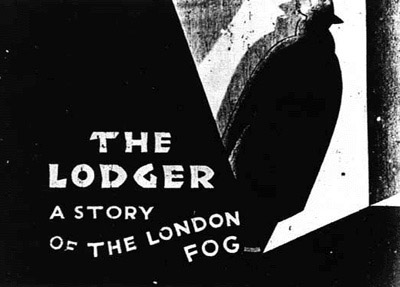
But now that this particular endeavor has shuttered for the summer, I find that there's a portly Englishman who has been waiting upon me patiently. Best not to keep him waiting, then. Especially when he's turned out the first film that critics are willing to label "a masterpiece": The Lodger: A Story of the London Fog.

I suppose another thing that might have kept me from jumping right into this film was the lousy quality of the print Netflix had available. The Lodger is actually an extra feature on the DVD of a later Hitchcock film, Sabotage (which we'll get to in it's time). As the disc's ugly stepchild, The Lodger clearly didn't get a lot of love from Laserlight or Vintage Films. The print skips, brightness changes wildly from shot to shot, titles vary so much that it's impossible to tell which ones comes from the original and which ones are more recent substitutes, and most criminally, the opening credits are so butchered that Hitchcock's own credit is cut off before it ever gets the chance to appear. I know it's an 80-year old movie, but this is the best we could do? I've got a project in mind for the film archivists out there.

Get past that, and we're in pretty familiar territory. A serial killer called "The Avenger" is murdering the curly-haired blonde women of London, and a creepy houseguest may be the culprit – or he might just be wrongfully accused. It even has the first Hitchcock MacGuffin, in the form of the hunt for The Avenger. It's almost like a parody of a typical Hitchcock plot. Although if you think about it, for Hitchcock to have found so many variations on this basic story over his career, it makes sense that he would start right at the source.

Hitchcock gets a lot of mileage out of his star. The mysterious tenant is played by Ivor Novello, who was a popular songwriter (Jeremy Northam plays him as the only real-life character in the abovementioned Gosford Park) and actually something of a heartthrob of the era (despite being homosexual; marketing gay men as sex symbols has always been the way of the entertainment industry). According to our old friend Patrick McGilligan, Hitchcock was a little concerned about the casting
of Novello, as the star was renowned for striking over-the-top romantic poses in his stage performances. Whatever his method, Hitchcock clearly found a solution. From the moment he first walks through the door, the mood is not romantic enchantment but extreme unease. Deathly pale, nervous, barely able to carry on a conversation, Novello's Lodger is a remarkable creation, especially knowing that an audience would completely assume he was the hero.

Whether it's Novello's performance or Hitchcock's directing, the character of the Lodger certainly comes out better than his prospective love interest, Daisy, who -- in another ahead-of-its-time gesture -- is played by a woman calling herself June. June doesn't do much in the way of acting. She laughs a lot. I mean a lot. Like a strangely uncomfortable scene wherein her father has fallen off a chair and she continues to laugh and laugh. Mmm, awkward. Every now and then, she's called upon to look vaguely uncertain. That's usually just a segue to a laugh, though. I wasn't a big fan of June's.

I wonder if audiences of the day identified more with Joe, the useless cop portrayed by Malcolm Keen. Quite frankly, Clair and I found him at least as creepy as Novello. With irises so pale as to make his eyes look hollow, a hilariously inept sense of romance (he slaps a pair of handcuffs on Daisy as an expression of interest), and a terrible crime-solving technique, he's just as unsettling as the guy being set up as the potential villain. In a way, the movie puts us in an unusual position from the get-go, with two possible bad guys and a heroine with no range. With no one to necessarily like, this is not a recipe for a great thriller.

This is where Hitchcock really asserts himself. With no vested interest in any of our leads, he still builds the suspense. It's never daytime in The Lodger's London. The populace is following news of the murders with rabid interest. Someone we suspect is actually innocent. Hitch knows how to play to the crowd. Sometimes I got bored during the movie, but I never lost interest in the outcome.

Did I say bored? Yeah, that's the real problem. Perhaps one of the greatest tricks as a viewer today is to get into the mindset of a viewer back then. Because even to an open-minded fellow like myself, The Lodger moves at a positively glacial pace.
There's very little dialogue (and for a silent film, that's saying something) and almost no action, so we're left with a great many static shots of people looking, waiting, building up a sense of importance that doesn't always pay off.

This is what kind of makes me think I enjoyed The Pleasure Garden a little bit more. This story is less melodramatic. The acting -- June aside -- is better. But The Lodger doesn't move. When the climactic chase scene finally comes, it ought to be the culmination. Instead, it's a relief.

Still, he's learning. Hitchcock told the famed director and journalist François Truffaut that he considered The Lodger to be his first movie. If so, it's a very assured debut. And it bodes well for things to come.

Of course, I don't want to give anything away.

Tuesday, May 15, 2007

Just a Quick Note From the Old Stomping Grounds...

Every now and then, one of my old You Don't Know Jack questions pops up. I can't help but get a sweet, wistful feeling whenever that happens. Most recently, one of my Jack Attacks was dusted off, updated to include the surviving spawn of Anna Nicole Smith, and slotted to close out the weekly game.

What makes me mention this is that the game has a comment section. And here's some of the warm reception that greeted my work:

"Ok.. the Jack Attack was just frigging cruel."

"I was doing pretty good until the Attack. *sigh*"

"Damn that Jack Attack."

"Wow, I can't believe how badly I sucked on that. It was truly impressive. I've never done that badly on a Jack Attack EVER, home or web versions."

"ZERO on the Jack Attack. ZERO!"

"This is the first time I haven't aced the Jack Attack... seriously... and I've never felt so happy."

"I voluntarily ignored the Jack Attack... I don't give a damn about celebrity gossip."

"I didn't even bother to touch the keyboard during the Jack Attack."

"That Jack Attack was pretty lame"

"I didn't even touch the keyboard during the Jack Attack. Just sat back and watched."

"Worst Jack Attack ever . . ."


For some reason, I'm simply overwhelmed with pride.

Friday, May 04, 2007

THE DAMNED HUMAN RACE: When She Says "Fight", She Really Means It

So I was strolling through the Sports Illustrated website, looking for more overwrought commentary about the Mavericks' miserable collapse at the hands of the Warriors, when I stumbled across this unusual link title:

Army's Meredith is cheerleader of week

Okay, you have my attention. I don't think I've ever seen the words "Army" and "cheerleader" in the same sentence, or at least not in the traditional cheerleading sense. But sure enough, the SI folks took time out to showcase Meredith Walton, cheerleader for the United States Military Academy.


Now we'll set aside the primary issue of whether or not I should be looking at pictures of cheerleaders 14 years younger than I am (or what the heck Sports Illustrated is doing plastering pictures of college cheerleaders all over its website). What really threw me for a loop is the fact that, on game days, she looks like this:


I mean, it makes sense. She's not just a senior. She's a senior at West Point. She's a cadet. So when the game's over, she hangs up the sweater and the tiny skirt and dons her country's uniform. Naturally.

This bugged me a lot, and I spent some time trying to figure out why. And I eventually came down to three faults of my own: arrogance, a lack of imagination, and fear.

I've always been of two minds about cheerleaders: sure, they're pretty. But they're also kind of dumb and pointless. Consider: they dress in uniform, they're relentlessly cheery no matter the situation, and they encourage everyone to think alike and act as a mob. (Actually, this explains a lot about the cheerleader we sent to Washington.) In short, I don't trust them, because I don't think they're capable of thinking for themselves, and they don't want anyone else to, either.

Arrogant, yes? Meredith seems to think so. Apparently, my attitude that bugs her, given her answer to the question, "What's a popular misconception about cheerleaders?"

That we are all dumb and peppy all of the time. I think I am pretty smart, and I have my frustrated, angry moments, too.


I hope she's pretty smart. She's studying to be an intelligence officer, which I realize doesn't merit the kind of respect it used to. But, I mean, the girl got into West Point. Sure, you can have connections, but you don't make it very long in a military academy without being a pretty smart cookie. So she's messing with my stereotypical disdain for cheerleaders. Except for being cute.

There's also the fear that I'm just a sexist pig. Do I have a problem with a pretty girl being in the military? I wouldn't have thought so. I think I'm a fairly pro-equality guy. Heck, I have a standing election policy of "When In Doubt, Vote for Women and Minorities." (Hillary is sorely testing this method.) So why should it bother me that an attractive woman would also want to serve in the military? I think it might be a kind of reverse sexism. Women have only been allowed in to West Point since 1976. It feels like a step backward to spend that opportunity leading cheers. Does MIT have cheerleaders? Why does the Army?

Therein lies my lack of imagination. Nowhere is it written that increased opportunities for women have to have some corresponding decrease in girliness. So Meredith wants to be in the Army. She also likes to wear a short skirt and cheer on the football team. She's an American; she wants it all. Who am I to say she shouldn't have it? She can cheer for her country, and she can die for it.

Ah, I think we've found it. Our armed forces are stretched as thin as can be. We've lost more American soldiers in Iraq than we lost civilians on September 11. The country is exhausted from four years of war, yet fiercely determined to support its troops and avoid the shameful treatment afforded veterans of Vietnam. And here, symbolizing our weakened-yet-resolute Army, is Meredith Walton. A future second lieutenant with pom-poms.

My third flaw: fear. Meredith Walton now stands as the face of the war for me. A sweet young all-American girl who might get shipped off to face death in a couple years, because we'll probably still be stuck in this mess by then. And I don't want her to die. She's a cheerleader, for pete's sake. Cheerleaders don't die in the desert. And frankly, neither should anyone else.

I definitely won't look at Sports Illustrated's Cheerleader of the Week again.

Monday, April 23, 2007

THE HITCHCOCK PROJECT: #2 - The Mountain Eagle... Sort Of


Two movies in, and the project is already in trouble.

1926 was a big year for Alfred Hitchcock. The Pleasure Garden had been a bit of an ordeal. On the advice of his cinematographer, in order to save money, he hadn't declared the motion picture film upon entering Italy. The customs agents weren't fooled; they confiscated the film, and it cost more money to have new film sent from Germany. He had the aforementioned incident with the actress who refused to go into the water while having her period; Hitchcock was so naive, he didn't know what a period was. He didn't care for the actor playing the villain.

Still, he had already proven to be a resourceful director. He convinced a waitress at a hotel to step in for the reluctant swimmer. He saved time and money by shooting extra material on the boat trip to the location. He finished the movie on time, and got pretty strong reviews. All in all, it was a superb first outing. So the studio was more than happy to hand him the reins for another film. The Mountain Eagle.

I haven't watched The Mountain Eagle. Why not? Well... why don't I let my friends at Wikipedia explain.

This is the only Hitchcock directed feature that is considered lost. No prints have been known to survive.


And boy, is it lost. How lost is it? Okay, you see that dog up there, in the movie poster? To this day, nobody knows what role (if any) the dog plays in the film. (He is clearly neither mountain nor eagle.) As far as I know, no one alive today has seen it. Certainly not our biographer, Patrick McGilligan. Nobody at all. And definitely not me.

So, that's just swell. My quest is stopped in its tracks before it has barely begun.

Except.

Look, it's not as though I was going to abandon the project. I mean, you can't really hold it against me that a movie doesn't exist anymore. And there's 51 movies to go. Besides, Hitchcock himself hated the movie. But it just killed me that I wouldn't be able to truly complete the entire Hitchcock oeuvre.

Cue Dan Aulier.

Stuck in my progress in the biography, I was doing some outside research, thumbing through a copy of Aulier's Hitchcock's Notebooks, when I made the surprising discovery of his surprising discovery. It seems that, although the film is lost, Hitchcock himself had a complete set of production stills. And Aulier was kind enough to reprint them in his book, along with a brief synopsis. So I couldn't watch The Mountain Eagle. But I could do the next best thing.

The story alone would classify this as a weird film. In the snowy mountains of Kentucky (?), we meet our main character: a nasty fellow named Pettigrew, who evidently hates everyone. Pettigrew's wife dies giving birth to a crippled boy. Pettigrew directs most of his anger at this mountain-dwelling hermit named John, who most people call "Fear o' God".

Cut to twenty-some-odd years later, when the son is now putting the moves on the local schoolmarm named Beatrice (played by movie beauty Nita Naldi, who Hitchcock had to browbeat into dressing down). Pettigrew goes to confront her about this, and ends up making advances on her himself. She turns him down, and the son disappears, probably out of embarrassment.

So now, Pettigrew is really angry. He tries to get Beatrice arrested as, and I turn to Wikipedia again for this description, "a wanton harlot." That's Fear o' God's cue to show up, marry Beatrice, take her back to his cabin in the woods, and get her pregnant. Facing these new developments, Pettigrew takes a new tack: he has Fear o' God arrested for murdering his missing son. Yes, this is a guy who loves to hate.

Fear o' God escapes the law, but not for long. He becomes ill, and Beatrice has to drag him into town for treatment. There Pettigrew is about to claim his victory... until his long-lost son suddenly shows up! Yes, the whole murder thing is out the window, and to top it off, somehow (the how is not made at all clear), Pettigrew is accidentally shot. So, truly a happy ending for everyone.

It would be strange enough that Hitchcock & company shot a film set in Kentucky in the mountains of Germany. (The snow was so heavy at one location that Hitch paid the local fire department to hose it away.) But this plot... it's just beyond bizarre. Why does Pettigrew hate so much? Why does Fear o' God rescue Beatrice? Why is everyone in the movie trying to get up her skirts? What is the heck is going on?

Want to see how weird this movie is? Here's your chance to see more of The Mountain Eagle than almost anyone alive. This was the only still I could find in Google Images, but I think it tells the tale.


Who is that handsome fellow? Who knows? Seems like he must be Fear o' God, but who can be sure? The important thing is, whoever that's supposed to be, it's a character in this film. Someone decided that the Cryptkeeper look was ideal for this movie. To which I can merely say, Wow.

I can't assess Hitchcock on this one, not without seeing the movie. But he didn't like the movie, and you kind of have to defer to his judgment on this. But I do know that, no matter how bad the movie may have been, things weren't all bad. It was around this time that he proposed marriage to Alma. And she said yes. (They were on a ship, and she was sick. Hitchcock said it was the only way he could trick her into it.) So he had a steady career, and now he was a newlywed. Good times.

Oh, and he was about to make his first great movie. That one, Netflix has.